Fixing “Malformed UTF-8 characters” in Laravel
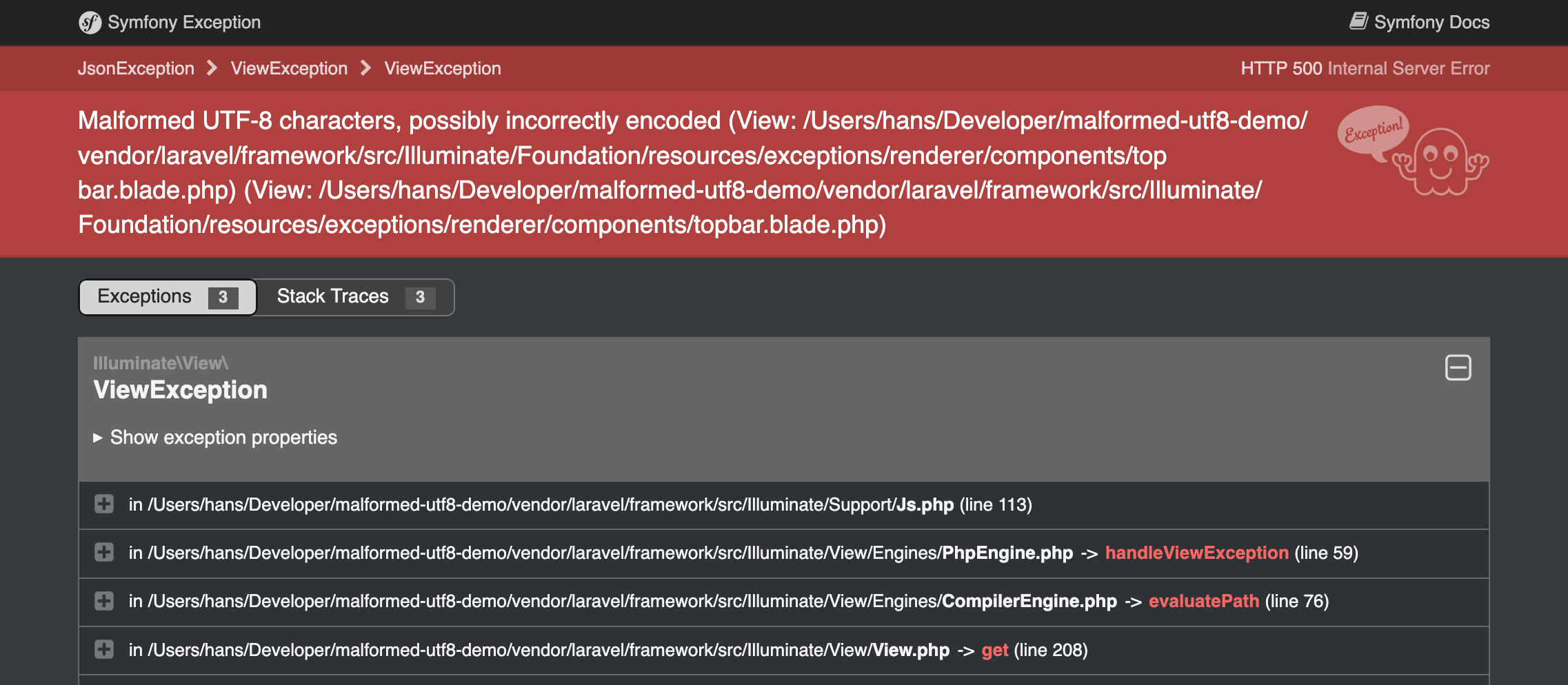
Malformed UTF-8 characters, possibly incorrectly encoded
If you have ever seen this exception, chances are that you are saving byte strings to the database
using a package like laravel-model-uuid.
A byte string is arbitrary byte data formatted as a string; bytes, with string as their vehicle.
This is great for efficiently storing small amounts of data, but as it’s arbitrary data, it’s not
valid UTF-8.
Problems arise when you try to display this data in a web browser or try to parse it somehow.
Normally speaking, you wouldn’t. So why do we see this Symfony exception page?
Cause
Laravel has a beautiful exception page that displays a lot of useful information about the exception that was thrown; the exception class and message, the stack trace, request and session details, and—relevant to what we’re doing—all SQL queries that have occurred during that request up until the point where the exception was thrown, along with their bindings1.
If the exception being rendered is a database exception, the relevant SQL query is also included in the message.
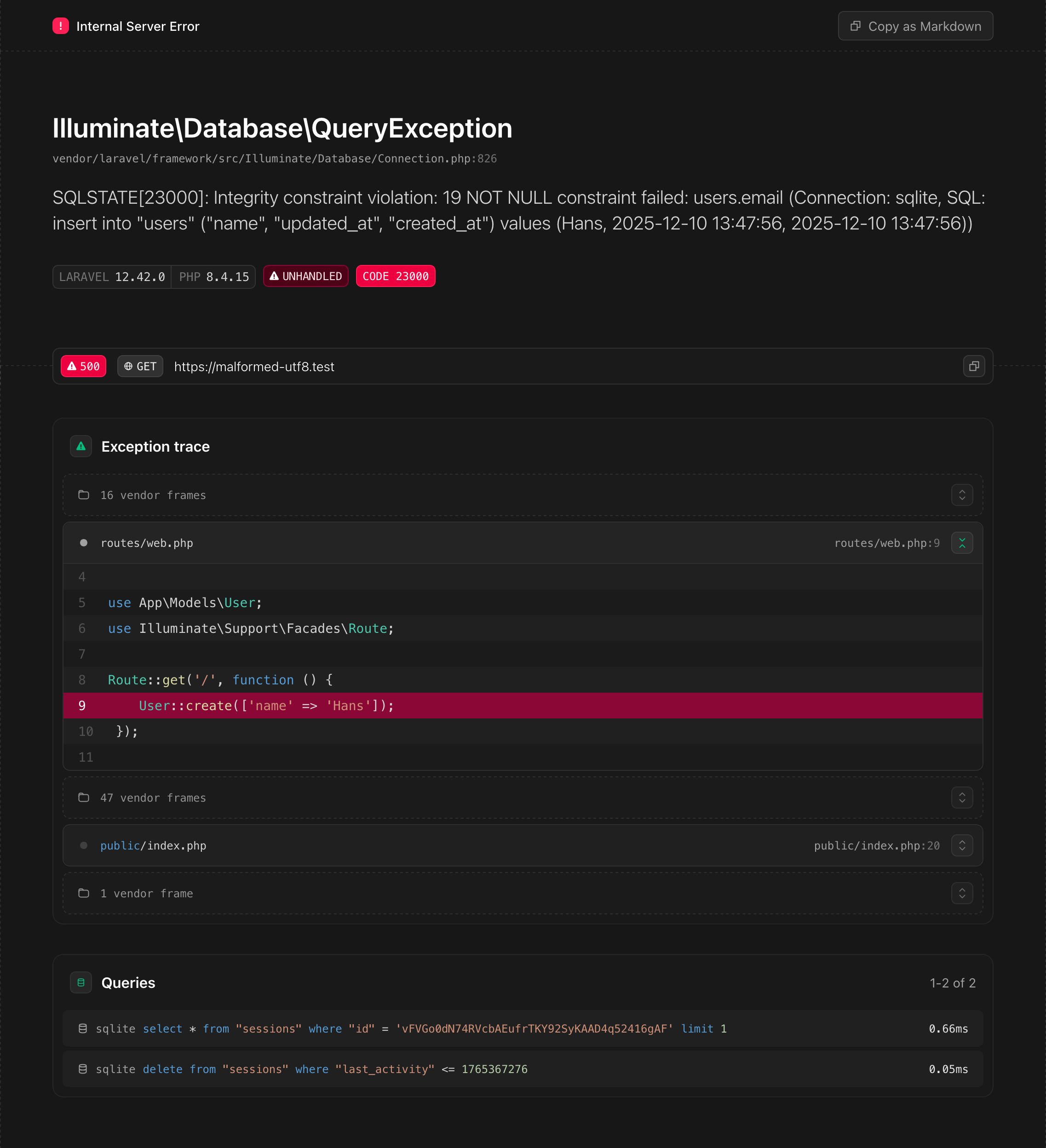
But what happens if this page itself fails to render?
Whenever something goes wrong, an exception is thrown. Relevant data is collected and written to a
log, sent to an error reporting service, a webhook for your chat service is triggered, whatever you
have configured config/logging.php. And the exception page is rendered.
If—somewhere in the request lifecycle—a byte string is involved in a database operation, this will also be included in the data being passed around, and that throws a spanner in the works.
At some point, the SQL query and its bindings will be parsed as JSON, and that function will fail, because this byte string is—indeed—not valid UTF-8. Now a new exception is thrown. That exception will be rendered as a Symfony exception page; a fallback for when the original exception page fails to render. And the original exception will be lost.
Solution
To solve this issue, we need to turn the byte strings into something that is actually valid UTF-8 before it is passed to something that expects valid UTF-8. There are three problems we need to solve:
- The bindings in a
QueryException’s message need to be sanitized - The bindings in the Queries section of the exception page need to be sanitized
- A bonus problem that we’ll tackle later
Let’s dive in.
Query exceptions
A Illuminate\Database\QueryException is thrown whenever a database operation fails. The message
contains the SQL query and its bindings. We can trigger one by trying to create a user where a
non-nullable field isn’t specified.
// No email specified
$user->create(['name' => hex2bin('deadbeef')]);
We will go right to the source, the place where the exceptions are thrown, and the data is passed to
them: Illuminate\Database\Connection::runQueryCallback. All this method does is run the query
callback, and if an exception is thrown, it will be re-thrown as a QueryException.
If this happens, we can sanitize the bindings before re-throwing the exception:
 1namespace App\Database;
 2
 3use Closure;
 4use Exception;
 5use Illuminate\Database\MySqlConnection;
 6use Illuminate\Database\QueryException;
 7use Illuminate\Database\UniqueConstraintViolationException;
 8
 9class ErrorSanitizingMySqlConnection extends MySqlConnection
10{
11    protected function runQueryCallback($query, $bindings, Closure $callback): mixed
12    {
13        try {
14            return $callback($query, $bindings);
15        } catch (Exception $e) {
16            // Sanitize bindings before creating the exception
17            $sanitizedBindings = sanitize_bindings($this->prepareBindings($bindings));
18
19            // […]
20
21            throw new QueryException(
22                connectionName: (string) $this->getName(),
23                sql: $query,
24                bindings: $sanitizedBindings,
25                previous: $e
26            );
27        }
28    }
29}We can’t override Illuminate\Database\Connection::prepareBindings (line 17), as that would
sanitize ALL bindings, including those that would successfully be inserted into the database.
As runQueryCallback is defined on Illuminate\Database\Connection, without any ways to hook into
it, we need to override the class for the database connection we are using, e.g.,
Illuminate\Database\MySqlConnection.
We sanitize the bindings with a helper that we will reuse later:
function sanitize_bindings(array $bindings): array
{
    return array_map(function ($binding) {
        if (! is_string($binding) || mb_check_encoding($binding, 'UTF-8')) {
            return $binding;
        }

        return '0x'.bin2hex($binding);
    }, $bindings);
}Now we need to make Laravel use our custom connection class.
Laravel is built with dependency injection as a core part of its architecture. This means that we
can swap out nearly any functionality the framework offers for our own implementation, including the
class used to manage database connections. We can do this by adding the following to
App\Providers\AppServiceProvider::boot:
Connection::resolverFor('mysql', function ($connection, $database, $prefix, $config) {
    return new ErrorSanitizingMySqlConnection($connection, $database, $prefix, $config);
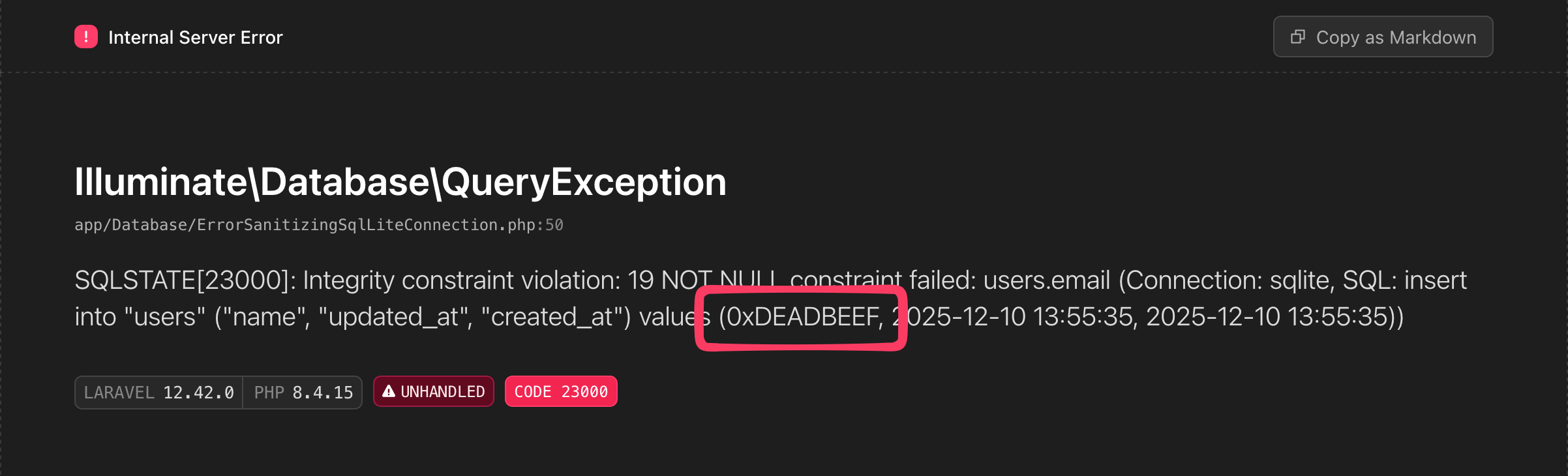
});And with these changes (source): Success! The exception renders correctly:
The Queries section
A QueryException’s message is not the only place where the SQL query and its bindings are
displayed. The Queries section of the exception page also displays them. So something like this will
still trigger the “Malformed UTF-8 characters” error:
User::find(1)->update(['name' => hex2bin('deadbeef')]);

throw new Exception('Whoops!');To solve this, we need to override the method responsible for rendering the exception. Or to be more precise, the method that generates the data for the Queries section.
 1namespace App\Exceptions\Renderer;
 2
 3use Illuminate\Foundation\Exceptions\Renderer\Exception;
 4
 5class ConfigurableFrameException extends Exception
 6{
 7    public function applicationQueries(): array
 8    {
 9        $queries = $this->listener->queries();
10
11        return array_map(function (array $query) {
12            $sql = (string) $query['sql'];
13
14            $sanitizedBindings = sanitize_bindings($query['bindings']);
15
16            foreach ($sanitizedBindings as $binding) {
17                $result = match (gettype($binding)) {
18                    'integer', 'double' => preg_replace('/\?/', (string) $binding, $sql, 1),
19                    'NULL' => preg_replace('/\?/', 'NULL', $sql, 1),
20                    default => preg_replace('/\?/', "'{$binding}'", $sql, 1),
21                };
22
23                $sql = (string) $result;
24            }
25
26            return [
27                'connectionName' => $query['connectionName'],
28                'time' => $query['time'],
29                'sql' => $sql,
30            ];
31        }, $queries);
32    }
33}This whole method is an exact copy of the parent method, except for the sanitized bindings (source).
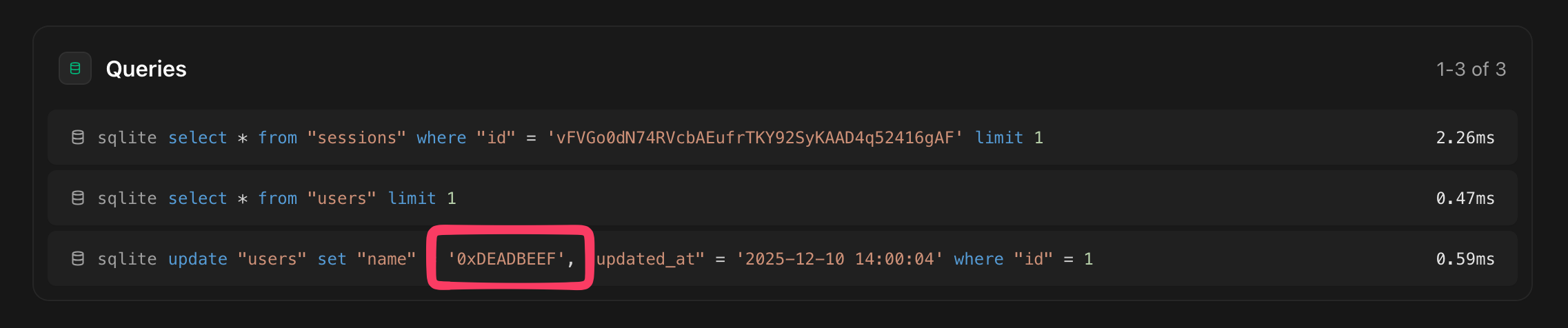
With that, all places where the SQL query and its bindings are displayed are sanitized and will not fail with a Malformed UTF-8 characters error anymore.
Bonus problem: Stacks
In fixing one problem, we have created another:
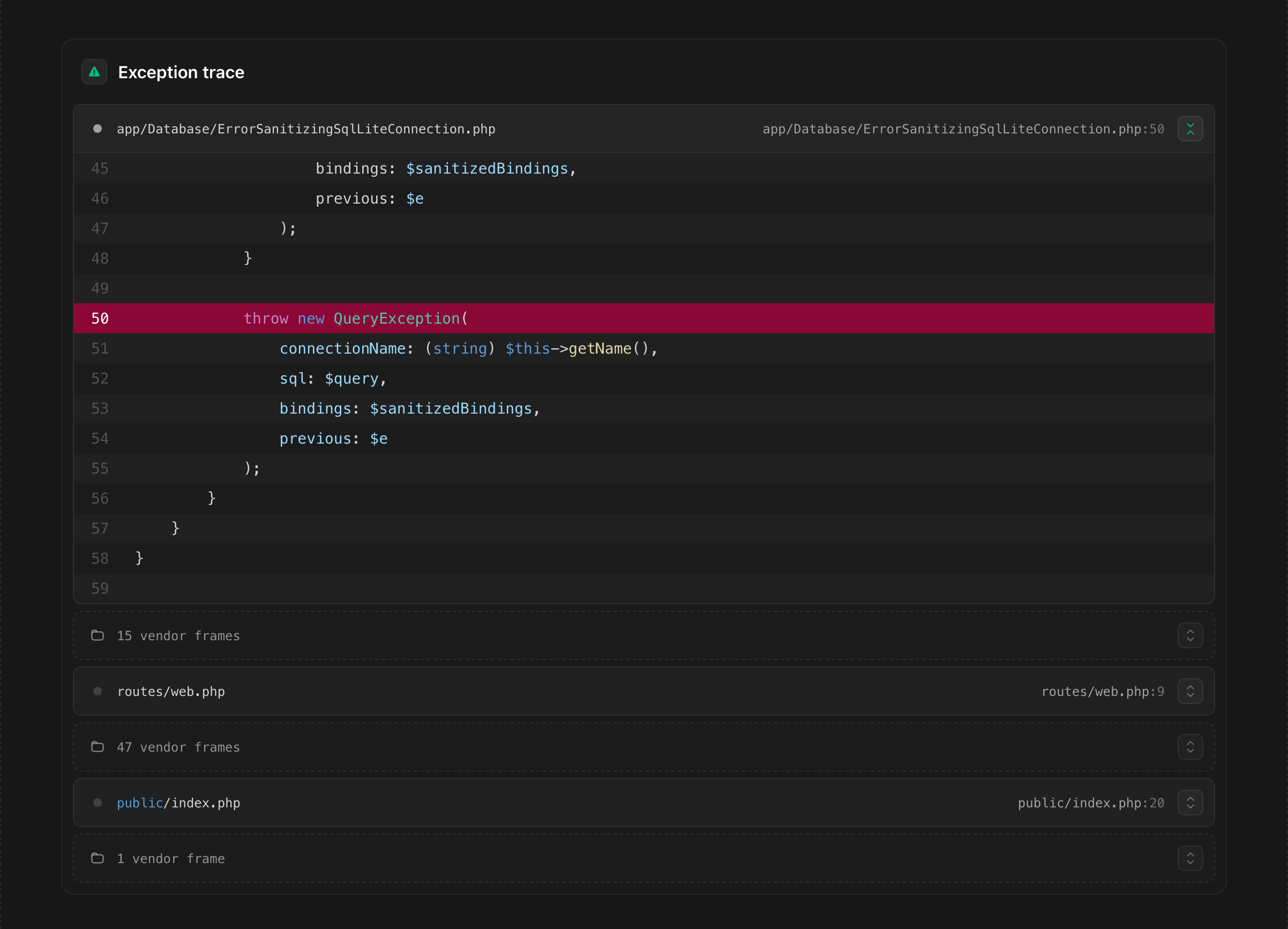
Because we have implemented our own exception renderer, the stack trace will now show our custom
Connection class as the first non-vendor class in the trace. While correct, it is not very
helpful, as it masks the place where the original error occurred.
We can fix this, but it is a little more involved. The process is as follows:
When an exception is thrown,
Illuminate\Foundation\Exceptions\Renderer\Renderertakes a request and a throwable and prepares the data to render the exception page: an instance ofIlluminate\Foundation\Exceptions\Renderer\ExceptionIt takes the stack trace frames and turn them into instances of
Illuminate\Foundation\Exceptions\Renderer\FrameThese frames are grouped based on whether they are ‘vendor frames’ or not
 1/**
 2 * Get the exception's frames grouped by vendor status.
 3 *
 4 * @return array<int, array{is_vendor: bool, frames: array<int, Frame>}>
 5 */
 6public function frameGroups()
 7{
 8    $groups = [];
 9
10    foreach ($this->frames() as $frame) {
11        $isVendor = $frame->isFromVendor();
12
13        if (empty($groups) || $groups[array_key_last($groups)]['is_vendor'] !== $isVendor) {
14            $groups[] = [
15                'is_vendor' => $isVendor,
16                'frames' => [],
17            ];
18        }
19
20        $groups[array_key_last($groups)]['frames'][] = $frame;
21    }
22
23    return $groups;
24}
Frames are grouped by whether they are considered a vendor frameThen finally, the
x-laravel-exceptions-renderer::traceview component will render the grouped frames.
So the best way to fix this is to tackle the problem at the source: Which classes are considered vendor classes?
To do this, we need to override the isFromVendor method of the Frame class, we need to override
the frames method of the Exception class to use the custom Frame, and we need to override the
render method of the Renderer class to use our custom frames. Feel free to inspect the code
changes here:
Treat custom SQL connection as vendor class
class ConfigurableFrame extends BaseFrame
{
    public function isFromVendor(): bool
    {
        return ! str_starts_with($this->frame['file'], $this->basePath)
            || str_starts_with($this->frame['file'], join_paths($this->basePath, 'vendor'))
            || array_any(
                config('app.classes_treated_as_from_vendor', []),
                fn ($ignored) => $this->class() === $ignored || ($this->frame['class'] ?? null) === $ignored
            );
    }
}
The repository is available on GitHub: pindab0ter/malformed-utf8-demo
Bindings are the values that are bound to the SQL query. Instead of the parameter placeholder
?, the actual value will be displayed. For example:↩︎-- With parameter placeholder: select * from "users" where "users"."email" = ? -- With bindings: select * from "users" where "users"."email" = "some.user@example.com"